
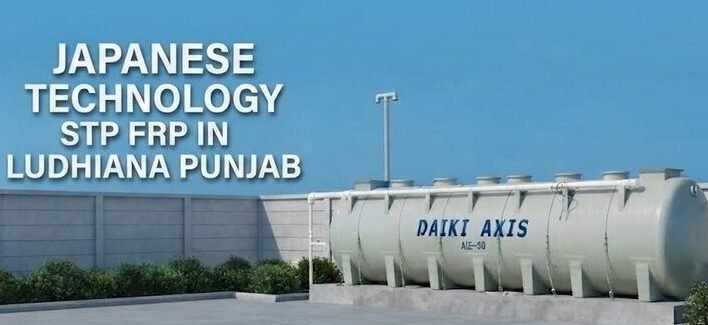
Ludhiana is one of Punjab’s major industrial and commercial hubs, with textile mills, hosiery units, manufacturing facilities, hotels, hospitals, housing societies, and commercial developments. As these sectors continue to grow, effective sewage treatment and wastewater management have become increasingly important.
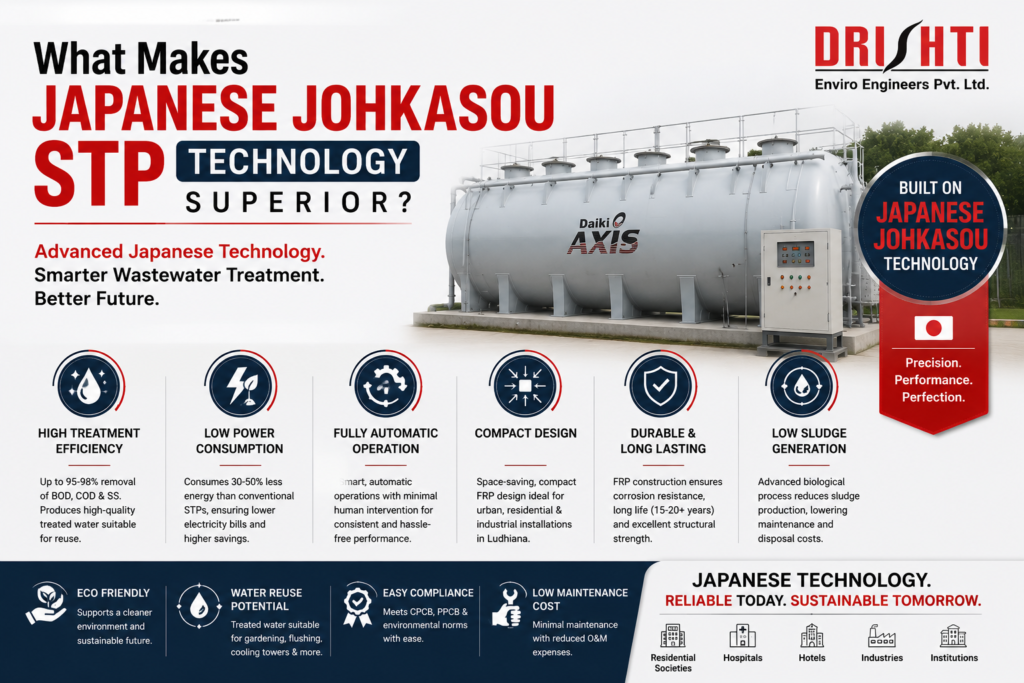
For facilities looking for a compact and reliable sewage treatment solution, Japanese Johkasou technology-based FRP Sewage Treatment Plants (STPs) offer a practical decentralized wastewater treatment option.
At Drishti Enviro Engineers Pvt. Ltd., we provide FRP STP plants in Ludhiana and across Punjab, using compact treatment systems designed for residential, commercial, institutional, and selected industrial applications.
What Is Japanese Johkasou Technology?
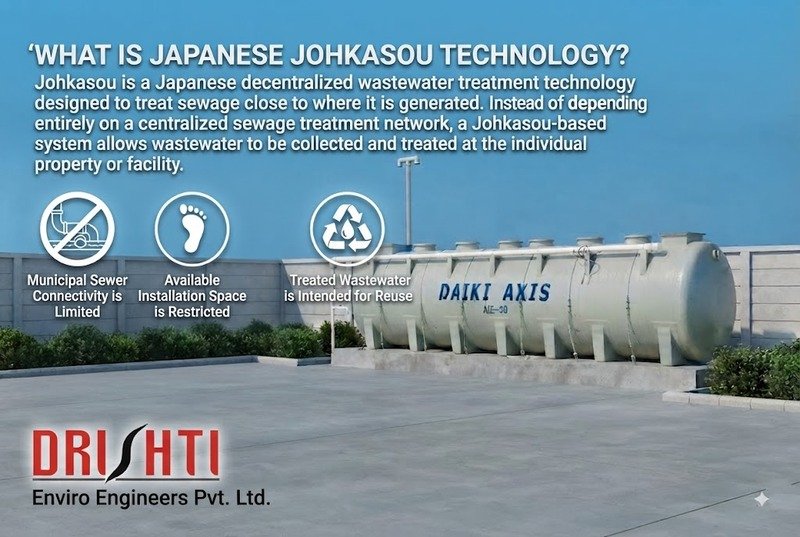
Johkasou is a Japanese decentralized wastewater treatment technology designed to treat sewage close to where it is generated. Instead of depending entirely on a centralized sewage treatment network, a Johkasou-based system allows wastewater to be collected and treated at the individual property or facility.
This makes the technology particularly useful for locations where:
- Municipal sewer connectivity is limited
- Available installation space is restricted
- A compact sewage treatment system is required
- Treated wastewater is intended for reuse
- Decentralized wastewater treatment is preferred
Johkasou systems have been widely used in Japan and are known for their compact design and integrated biological treatment process.
Why Choose an FRP Sewage Treatment Plant?
The use of FRP (Fibre-Reinforced Plastic) tanks is one of the major advantages of modern packaged STP systems.
1. Corrosion Resistance
FRP is resistant to corrosion and is suitable for wastewater treatment environments where conventional metal tanks may be vulnerable to corrosion.
2. Lightweight Construction
Compared with conventional RCC structures, FRP tanks are lightweight and can be easier to transport, handle, and install.
3. Compact Design
Packaged FRP STPs require comparatively less space, making them suitable for:
- Factories
- Hotels
- Hospitals
- Schools and institutions
- Residential societies
- Commercial buildings
- Industrial premises
4. Faster Installation
Because the treatment tank is manufactured as a packaged unit, installation can be simpler and faster than constructing a complete conventional treatment structure on site.
5. Suitable for Space-Constrained Sites
Industrial areas in and around Ludhiana often have limited available space. A compact FRP STP plant can therefore be considered where a conventional large-footprint STP is difficult to accommodate.
How Does a Johkasou-Based FRP STP Work?
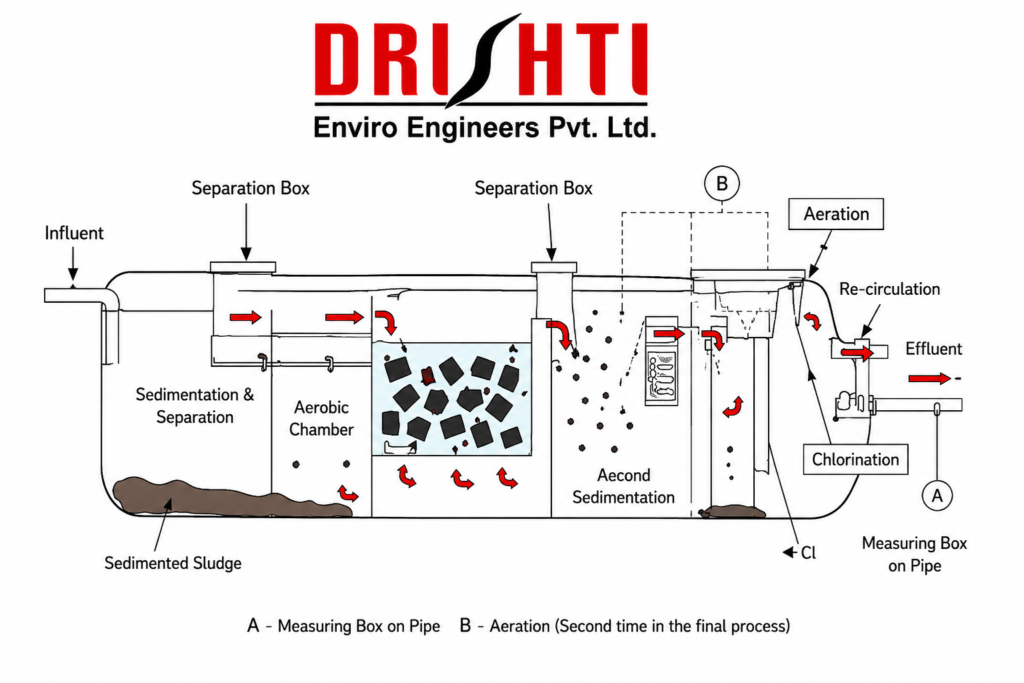
A packaged FRP STP generally uses a series of biological and physical treatment stages to reduce organic matter and suspended solids from domestic sewage.
Depending on the specific system design, the treatment process may include:
1. Primary Settling
Incoming sewage enters the treatment system, where heavier solids settle and initial separation takes place.
2. Biological Treatment
Microorganisms break down biodegradable organic matter under controlled treatment conditions.
3. Aeration
Air is supplied to support aerobic microorganisms responsible for biological wastewater treatment.
4. Sedimentation
Biological solids are separated from the treated wastewater.
5. Disinfection
The treated water can undergo an appropriate disinfection process before discharge or permitted reuse.
The exact treatment configuration and performance depend on the STP capacity, influent characteristics, technology selected, and applicable regulatory requirements.
Where Can FRP STP Plants Be Used in Ludhiana?
FRP packaged STPs can be considered for a variety of applications where domestic sewage is generated.
Common applications include:
- Textile and hosiery facilities
- Factories and industrial premises
- Hotels and restaurants
- Hospitals and healthcare facilities
- Schools and colleges
- Residential apartments and housing societies
- Commercial buildings
- Institutional campuses
- Builders and real estate projects
For industrial units, it is important to distinguish between domestic sewage and industrial effluent. Industrial wastewater may require a separate Effluent Treatment Plant (ETP) depending on its characteristics and applicable pollution-control requirements.
How to Select the Right FRP STP Capacity?
Choosing the correct STP capacity is one of the most important steps in a wastewater treatment project.
Capacity should not be selected simply by looking at the size of the building or factory. It should be calculated based on factors such as:
- Number of users
- Water consumption
- Expected sewage generation
- Operating hours
- Peak flow
- Future expansion
- Type of facility
- Applicable regulatory requirements
For example, an apartment complex, hotel, hospital, and factory may have very different wastewater generation patterns even if they have similar built-up areas.
A professional STP manufacturer or wastewater consultant in Ludhiana can assess these factors and recommend an appropriate treatment capacity.
| STP Capacity | Estimated Starting Price |
|---|---|
| 5–10 KLD | Starting from ₹2 Lakh |
FAQs
1. What is Johkasou technology?
Johkasou is a Japanese decentralized sewage treatment technology for treating wastewater near its source.
2. What is an FRP STP?
An FRP STP uses Fibre-Reinforced Plastic tanks for compact and corrosion-resistant sewage treatment.
3. Are FRP STPs suitable for Ludhiana?
Yes, they are suitable for residential, commercial, institutional, and selected industrial applications.
4. What capacity STP do I need?
It depends on your wastewater generation, number of users, and project requirements.
5. What is the cost of an FRP STP?
A 5–10 KLD FRP STP can start from around ₹2 Lakh. Final cost depends on the project and site requirements.
6. STP vs ETP – what is the difference?
STP treats domestic sewage, while ETP treats industrial wastewater.
Why Choose Drishti Enviro?
Drishti Enviro is a trusted environmental engineering company offering end-to-end water and wastewater treatment solutions for industrial, commercial, and municipal projects.
Why Partner With Us?
- ✅ Customized Water Treatment Plant (WTP) solutions based on your water quality and industry requirements.
- ✅ Advanced Japanese Technology FRP STP systems with compact, plug-and-play design.
- ✅ Complete Zero Liquid Discharge (ZLD) solutions for water recovery and regulatory compliance.
- ✅ High-performance Industrial & Commercial RO Plants for purified process and drinking water.
- ✅ Turnkey services including design, manufacturing, installation, commissioning, and AMC support.
- ✅ Energy-efficient, reliable systems designed to meet CPCB and State Pollution Control Board guidelines.
Contact Details :-
Phone: 9815564242
Email: drishtienviro1975@gmail.com
Address: Moti Nagar, Ludhiana, Punjab
Website: www.drishtienviro.in
Drishti Enviro – Aapka Trusted Partner for a Cleaner Ludhiana!
Sewage Treatment Plant Manufacturer in LudhianaSewage Treatment Plant Manufacturer in Ludhiana
Sewage Treatment Plant Manufacturer in Ludhiana
top 2 ETP Manufacturer in India | Water Treatment Solutionstop 2 ETP Manufacturer in India | Water Treatment Solutionstop 2 ETP Manufacturer in India | Water Treatment Solutionstop 2 ETP Manufacturer in India | Water Treatment Solutions